The buffalo drawn plough, a cornerstone of agricultural practices for centuries, remains a vital tool in many parts of the world. While modern machinery has transformed large-scale farming, the buffalo drawn plough continues to offer a sustainable, affordable, and accessible solution for smallholder farmers, particularly in regions where access to motorized equipment is limited. Its enduring relevance highlights a powerful intersection of tradition, practicality, and economic viability, impacting food security and livelihoods across diverse communities.
Historically, the buffalo drawn plough represents a significant advancement in agricultural technology, enabling more efficient land preparation than manual methods. Today, its importance extends beyond simple tillage. It embodies a low-cost, low-tech pathway to increased agricultural productivity, reducing reliance on expensive fossil fuels and promoting ecological sustainability. Understanding the nuances of its design, application, and ongoing evolution is crucial for fostering resilient agricultural systems in a changing world.
The resurgence of interest in traditional agricultural techniques, coupled with a growing awareness of the environmental impacts of industrial farming, positions the buffalo drawn plough as a relevant and valuable component of modern sustainable agriculture. This humble tool continues to play a critical role in food production for millions globally, and its adaptation to contemporary challenges ensures its ongoing significance.
The Global Significance of the Buffalo Drawn Plough
The buffalo drawn plough holds immense global significance, particularly in regions of Asia, Africa, and South America, where small-scale agriculture forms the backbone of local economies. According to the Food and Agriculture Organization (FAO) of the United Nations, these smallholder farms produce a significant portion of the world’s food, and the buffalo drawn plough is a crucial tool for their productivity. Its impact extends beyond mere food production, influencing rural employment, economic stability, and cultural heritage.
However, access to even this relatively simple technology isn't universal. Challenges such as affordability, maintenance, and the availability of suitable buffalo breeds pose obstacles to its widespread adoption. Addressing these challenges is paramount to realizing the full potential of the buffalo drawn plough in enhancing food security and improving the livelihoods of millions of farmers.
Defining the Buffalo Drawn Plough
The buffalo drawn plough is a farming implement pulled by water buffalo (or oxen, depending on regional availability) to turn and break up soil, preparing it for planting. It's a more advanced tool than traditional hoeing or digging, significantly reducing labor requirements and increasing the area of land that can be cultivated. The plough's design varies regionally, adapting to specific soil types and agricultural practices, but the core principle remains consistent: utilizing animal power to mechanically till the land.
Its connection to modern industry lies in its role as a foundational technology that paved the way for more complex agricultural machinery. Understanding its principles provides valuable insight into the evolution of farming techniques and the ongoing quest for sustainable agricultural solutions. Furthermore, the buffalo drawn plough addresses a critical humanitarian need by providing a low-cost, accessible means of food production in areas where modern technology is unattainable.
The impact of this tool extends to promoting soil health through aeration and improved water infiltration. This contrasts with more aggressive industrial tilling methods which can degrade soil quality over time. Therefore, a correctly used buffalo drawn plough fosters long-term agricultural sustainability.
Core Components & Design Considerations
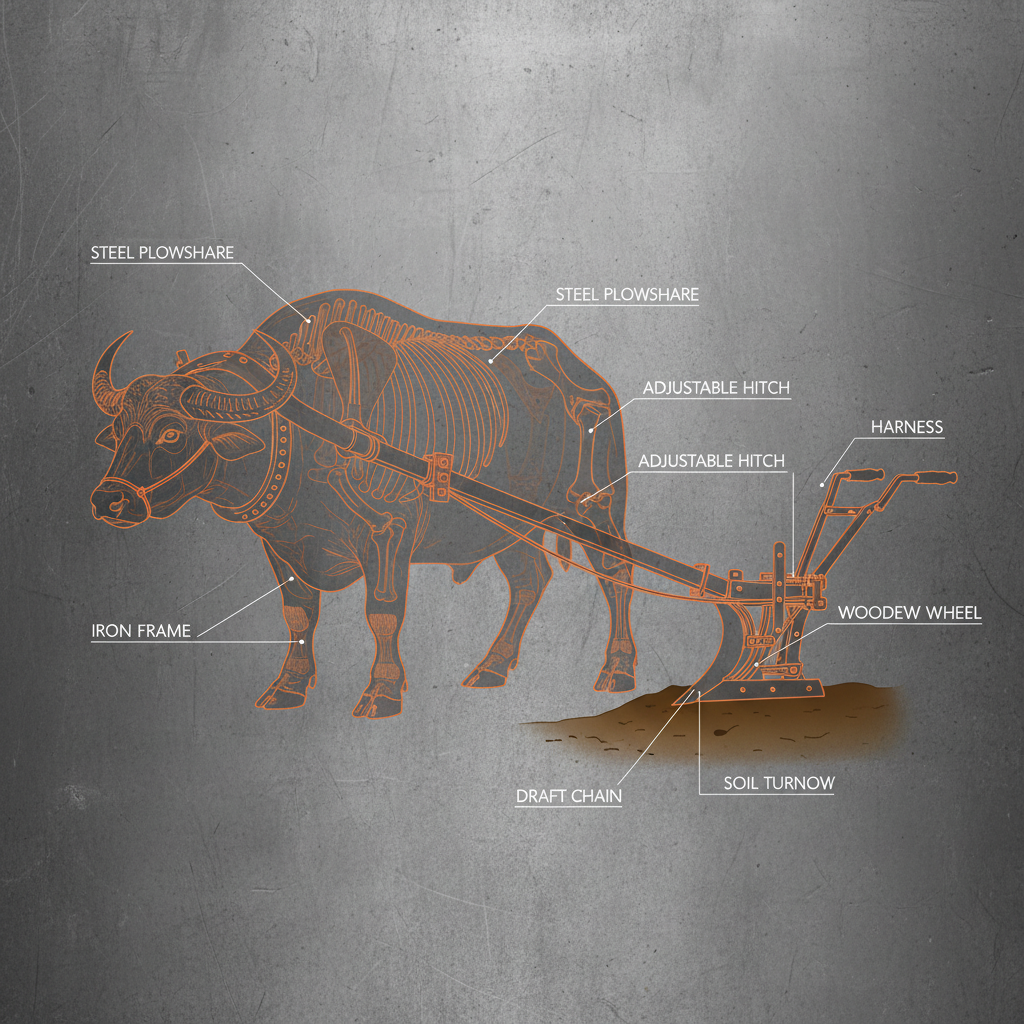
Several key factors determine the effectiveness of a buffalo drawn plough. The ploughshare, the blade that cuts into the soil, must be appropriately shaped and hardened to withstand wear and tear. The beam, which connects the ploughshare to the yoke, needs to be strong enough to handle the pulling force. The moldboard, responsible for turning the soil, influences the quality of tillage, and the handle allows the farmer to control the plough's depth and direction.
Design considerations must also account for regional variations in soil type, moisture content, and buffalo breed. For example, heavier soils require ploughshares with a wider footprint and stronger construction. The angle of the moldboard must be adjusted to optimize soil turning for different soil conditions. Regular maintenance, including sharpening the ploughshare and lubricating moving parts, is essential for ensuring optimal performance and extending the plough’s lifespan.
The yoke, which connects the plough to the buffalo, is also a critical component. It must be properly fitted to the animal to prevent discomfort or injury. A well-designed yoke distributes the pulling force evenly, maximizing efficiency and minimizing strain on the buffalo. The overall weight distribution of the plough also impacts its ease of use and effectiveness.
Applications Across Diverse Agricultural Landscapes
The buffalo drawn plough finds application in a wide range of agricultural landscapes, from the paddy fields of Southeast Asia to the undulating farmlands of Africa. It’s particularly well-suited for preparing land for rice cultivation, maize farming, and the planting of various vegetables and legumes. The versatility of the plough allows farmers to adapt their cultivation practices to suit local conditions.
In post-disaster relief operations, the buffalo drawn plough can play a vital role in quickly restoring agricultural productivity. By providing a means to rapidly till land, it enables communities to resume food production, reducing reliance on external aid. Similarly, in remote industrial zones with limited infrastructure, the buffalo drawn plough offers a sustainable solution for preparing land for agricultural projects.
Buffalo Drawn Plough Performance Metrics
Advantages & Long-Term Benefits
The advantages of utilizing a buffalo drawn plough are numerous. The most significant is its cost-effectiveness, requiring minimal financial investment compared to motorized equipment. This accessibility makes it an invaluable tool for resource-poor farmers. Furthermore, its reliance on animal power reduces dependence on fossil fuels, contributing to environmental sustainability.
Beyond economic and environmental benefits, the buffalo drawn plough fosters social impact. It empowers local communities by providing a means of self-sufficiency and reducing reliance on external aid. The relatively simple technology also facilitates knowledge transfer and local repair, ensuring long-term sustainability and reducing the need for specialized expertise. The tool enhances food security by enabling increased agricultural yields, and promotes the dignity of labor through a human-powered approach to farming.
Future Innovations and Sustainable Practices
Future innovations for the buffalo drawn plough focus on enhancing efficiency and animal welfare. Research is ongoing to develop lighter plough designs, reducing the physical strain on buffaloes and improving their productivity. Integrating ergonomic handles and adjustable features can further optimize the farmer's experience.
Sustainable practices, such as integrating the plough with conservation tillage methods, can further enhance its environmental benefits. This involves minimizing soil disturbance and maximizing the retention of organic matter, contributing to healthier soils and increased carbon sequestration. Utilizing locally sourced materials for plough construction also promotes sustainability and supports local economies.
Addressing Challenges & Optimizing Performance
Despite its many advantages, the buffalo drawn plough faces challenges such as the availability of suitable buffalo breeds and the potential for animal fatigue. Addressing these concerns requires careful consideration of animal welfare and the implementation of sustainable farming practices. Proper training in animal handling and plough maintenance is also crucial for maximizing performance.
Optimizing performance involves adapting the plough to specific soil conditions and implementing appropriate tillage techniques. For example, in heavy clay soils, multiple passes with the plough may be necessary to achieve adequate tillage. Regular maintenance, including sharpening the ploughshare and lubricating moving parts, is essential for ensuring long-term efficiency.
Investing in breeding programs to improve buffalo breeds and promoting the adoption of sustainable animal husbandry practices will further enhance the benefits of the buffalo drawn plough. Collaborative efforts between researchers, farmers, and policymakers are essential for overcoming these challenges and unlocking the full potential of this vital agricultural tool.
Comparative Analysis of Buffalo Drawn Plough Performance Factors
| Soil Type |
Buffalo Breed |
Plough Design |
Tillage Depth (cm) |
| Sandy Loam |
Murrah |
Traditional Mouldboard |
15-20 |
| Clay Loam |
Nili Ravi |
Improved Mouldboard |
20-25 |
| Silty Soil |
Jaffarabadi |
Lightweight Plough |
10-15 |
| Sandy Soil |
Bhainsa |
Subsoil Plough |
25-30 |
| Loamy Sand |
Carolina |
Share Plough |
12-18 |
| Heavy Clay |
Water Buffalo (mixed breed) |
Reinforced Mouldboard |
25-30 |
FAQS
Regular maintenance is crucial for maximizing the lifespan and efficiency of your buffalo drawn plough. This includes sharpening the ploughshare at least twice a year, lubricating all moving parts with grease or oil to reduce friction, and inspecting the beam and yoke for cracks or damage. Additionally, properly storing the plough when not in use, ideally under shelter, will protect it from the elements and prevent corrosion. Neglecting maintenance can lead to reduced performance and costly repairs.
The buffalo drawn plough is versatile but performs best in loamy and sandy loam soils. These soils offer a good balance of texture and drainage, allowing the plough to easily cut through the earth. Heavy clay soils require more effort and may necessitate multiple passes. Very sandy soils can be difficult to till effectively. The correct ploughshare design, tailored to the specific soil type, significantly impacts performance.
The buffalo drawn plough offers significant sustainability advantages over motorized tillage. It relies on renewable animal power, eliminating the need for fossil fuels and reducing greenhouse gas emissions. It also promotes soil health by minimizing compaction and encouraging organic matter accumulation. While motorized tillage may be faster, the buffalo drawn plough’s lower environmental impact makes it a more sustainable choice, particularly for smallholder farmers.
When selecting a buffalo breed for ploughing, consider its strength, stamina, and temperament. Breeds like Murrah, Nili Ravi, and Jaffarabadi are known for their suitability for draught work. Ensure the buffalo is properly trained and accustomed to wearing a yoke. Pay attention to the animal’s health and well-being, providing adequate nutrition and rest. A healthy and well-cared-for buffalo will be more productive and reliable.
A well-maintained buffalo drawn plough can have a remarkably long lifespan, often exceeding 20 years or more. The key to longevity lies in regular maintenance, including sharpening the ploughshare, lubricating moving parts, and protecting the plough from the elements. Using high-quality materials for construction and performing timely repairs will also extend its lifespan. Proper storage during the off-season is crucial.
Yes, the buffalo drawn plough is surprisingly adaptable. Beyond traditional row crop farming, it can be modified for use in conservation tillage systems, raised bed agriculture, and even for creating irrigation channels. Adjustments to the ploughshare and mouldboard can optimize its performance for different tasks. Its versatility makes it a valuable tool for promoting diverse and sustainable farming practices.
Conclusion
The buffalo drawn plough, while seemingly simple, represents a powerful intersection of tradition, practicality, and sustainability. Its enduring relevance in agricultural practices worldwide underscores its importance as a tool for food security, economic empowerment, and environmental stewardship. Understanding its core principles, advantages, and future potential is vital for fostering resilient agricultural systems and improving the livelihoods of millions of smallholder farmers.
Looking ahead, continued innovation in plough design, combined with the adoption of sustainable farming practices, will further enhance the benefits of this invaluable tool. By investing in breeding programs, providing training in animal handling, and promoting knowledge sharing, we can unlock the full potential of the buffalo drawn plough and ensure its continued contribution to a more sustainable and equitable future. Visit our website at buffalo drawn plough to explore how we support sustainable agriculture.